Showing posts with label Musa basjoo. Show all posts

Thursday, December 16, 2010

How to Winter Over Your Banana Plant in the Northeast


Wintering over a tropical banana in Northeast, Connecticut (Zone 5-6) is easier than you think.
To find out your zone you can go to our website and enter your zip code. A zone number will appear. Or you can look at a USDA Zone Map.

First, the two bananas that we discuss in the video below are the Musa basjoo, our true hardy banana (Zone 4) and Musa sikkimensis, a banana that is a little more sensitive to the cold but can be grown in Zones 5 or higher. These bananas are grown for their defining tropical look in a garden.


The Musa Basjoo grows so fast it can produce up to a leaf a day. Musa sikkimensis is grown for its red underside and adds a splash of color to its large leafed foliage. Both bananas grow extremely fast when given full sun, plenty of water and lots of fertilizer. It's not unusual for the height to get upwards of twelve feet in one growing season. Finally, although they don't produce bananas, they do have the ability to flower, which is also edible. See our new book,Growing Tasty Tropical Plants for more details.


Monday, August 16, 2010

Keep Your Tropical Plants Looking Good!

Summer's not over yet and with a little bit of attention your tropical plants can still bring lots of color and joy to your living space. When mid-August arrives, the growth of summer is at its fullest. Managing this growth is simply a matter of trimming, pruning, and fertilizing. Sometimes removing the old flowers and turning the pot is all that is needed. With a little focus on care, my tropical plants were spruced up in about an hour. Of course, before looking with a critical eye, I made sure to look at the beauty before me and appreciate the lush growth of the season.


These flowering maples (abutilons), which love partial shade, are at my front door and are such a great contrast to the black solar fence. Abutilon ‘Kristen’s Pink’, ‘Vodoo’ (the red one), and ‘Bartley Schwartz’ (the orange one) are happily growing. I fertilize these with an organic topical feed about once a week.

Next to the Abutilons, I’ve used Salvia’s as a border plant. The Salvia gaurantica ‘Black and Blue’ and Salvia coccinea ‘Peach’ attract a multitude of hummingbirds every morning.

Enough admiring, now it was time to get to work. My old but trusted pruning gear.

I removed the dead lower leaves of this Lemon Grass potted in a blueberry pottery container. I found this pot at a yard-sale last year for $2.


Nicely groomed, it was time to take a picture of Lemon Grass. I use lemon grass in tea and it is also used as a favorite ingredient for Asian cooking.

My Mandevilla Sun Parasol ‘Giant Crimson’ that grew inside last winter, is in non-stop full bloom this summer. However, it needed its old flowers removed.


A close-up of the discoloration of old blooms.

Now the new flowers looked better and the buds about to open have room to fully display their magnificient color.


The Geraniums needed a few dead leaves and branches removed.


The two plants in this container, Pelargonium Balcon Royale Red, and Desrumeaux started out as plugs only 8 weeks ago.


Angel’s Trumpets (Brugmansia) are always fast growers in the summer. They are heavy feeders and need fertilizer at least twice a week with plenty of water.


This Brugmansia I’m making into a standard. I won’t be able to identify this one until it blooms.

This is my Angel's Trumpet, Brugmansia “Angel’s Summer Dream” grown as a standard. I love the multitude of blooms. This was in a 4 inch pot in mid-June.

Origanum ‘Kent Beauty’ (oregano) started as a single 2 1/2" pot in June. I fertilize this once week.


My three year-old Hardy Banana, Musa Basjoo is in need of fertilizer. Notice the lime green leaves.

My other three-year-old hardy Banana in the lower gardens and has been well fed. Notice the dark green leaves.


A view from afar

A new Bamboo to be released next Spring. We test our plants for at least a year before we release them in our catalogue

Simply turning the Bamboo gave it a whole new look.

Ficus 'Chicago Hardy' Fig growing in my garden. This has been wintered over twice and is in its third year of growth.

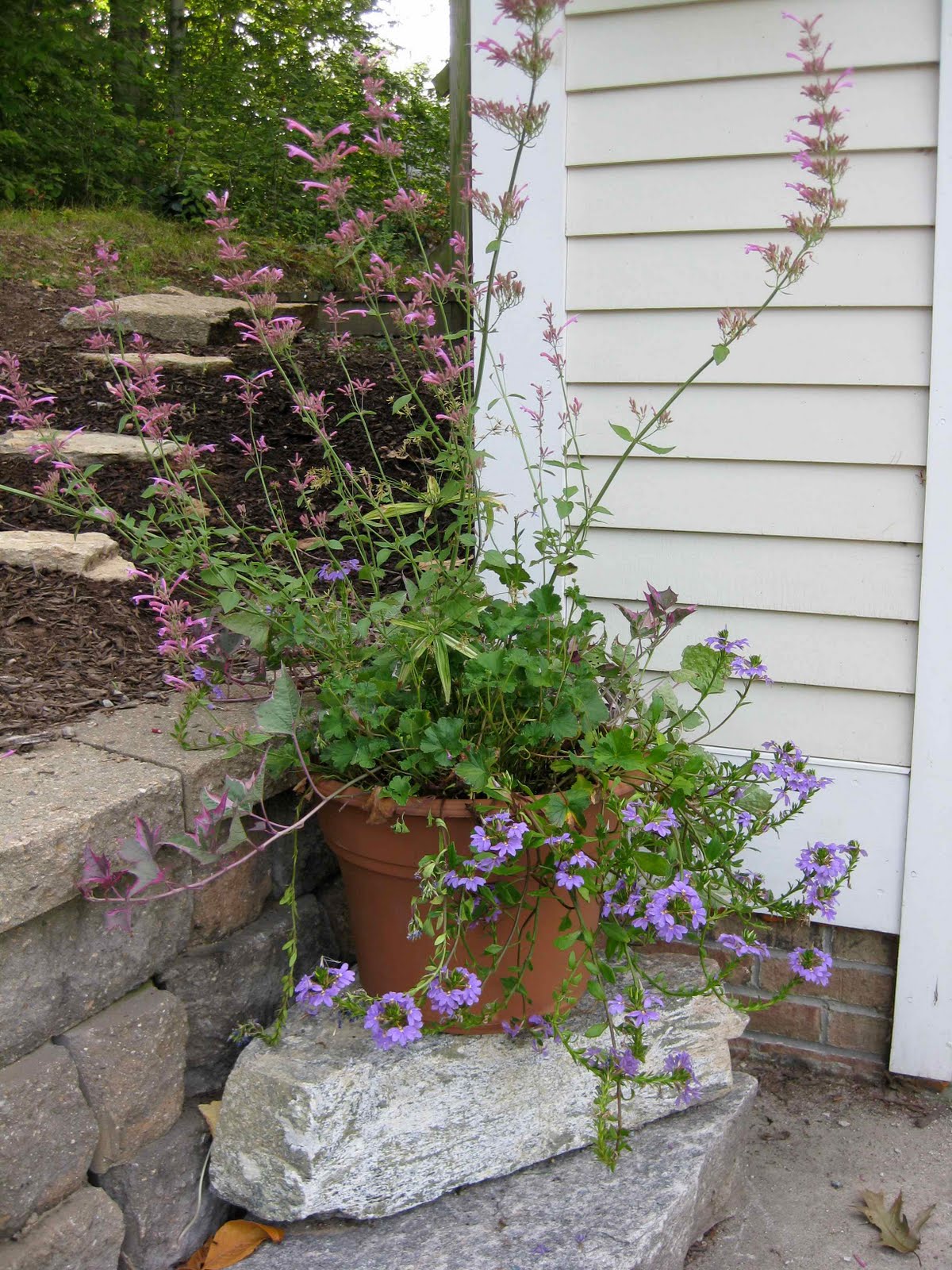
One of my mixed containers with growth gone wild. The variegated Ipomoea batatas 'Pink Frost' and the Scaevola aemula "Fan flower" (bluish,purple) draping over the tall flowering pink Agastache 'Tutti Frutti'.


The wild look contained.

Tuesday, July 13, 2010

July Heat Wave at Logee's

Like most of the country, this past week and a half has been humid and hot. How do tropical plants do in this weather? Mostly the plants, as long as they are kept well-watered, do well and in fact, is a time that our plants rapidly grow. The workers on the other hand get here at 7 am to water plants and get their "hot" work done before the heat of the day is upon them. However, the greenhouses can reach temperatures up to 105 degrees and our staff needs to keep well-hydrated to complete their daily tasks. This year, we are in the middle of building an energy efficient greenhouse so many of our plants are growing outside this summer. Take a look.


Two Angel's Trumpet standards with colorful hanging baskets on either side of our front entrance.


Pelargoniums adding a relief of color to the outside oppressive humidity.


Rows of Bananas growing fast in the heat. Musa 'Dwarf Lady Finger' and Musa 'Double Mahoi' are growing here in 4-inch pots.


A "Hardy Banana" Musa basjoo is rapidly growing in a 10 gallon pot.


Trays of Buddleia davidii 'Peacock'. Some of the flower bracts have gone by and will be groomed before they are shipped.


Solanum quitoense "Naranjilla" a new variety with heart-shaped purple leaves is an unusual plant that produces small orange edible fruit.


Healthy looking "Chocolate plants" or Theobroma cacao are on a cart getting ready to find a growing spot for the holiday season.


A large specimen "clown fig" Ficus aspera grown for its variegated fruit.


"Angel's Summer Dream" Brugmansia is known for its ability to grow and flower at less than a foot. Pictured here it is grown as a standard and is about 6 feet tall.


Papaya's love the heat and can create fruit this size in less than a year. This Carica papaya 'T.R. Hovey' is about 6 feet tall and is a three-year old specimen.


Little papayas shown growing in 4-inch pots.


The new greenhouse structure on the left and hibiscus growing on the right.


Here's a close-up of Hibiscus 'Estelle K'. Its orange blossom is large and magnificent and glows the fiery heat of the sun.


A new colocasia to be released this fall called 'Thai Giant.' It has happily grown in our test gardens for two years. The leaf span will reach 4 feet across by the end of the summer.


Finally, this hardy perennial "Bouncing Bet" Saponaria officinalis 'Flore Pleno'- is growing outside of Logee's retail store and is perky as ever on this 95 degree day.

Friday, April 16, 2010

Tropical Plants in the Outdoor Garden Waking UP!

Today's blog, although not as colorful with flowers, I hope will be useful for gardener's in the north who crave the beauty and exotic nature of tropicals. Of course, the first plant that I think every outdoor garden should have is the "Hardy Banana" Musa basjoo. Although, bananas are not produced from this variety, the defining tropical look of banana leaves growing in a northern garden is delightful and a mind boggler.

At Logee's our stand is now four years old and every year keeps getting bigger and bigger.
The chicken wire and hay is Hardy Banana's resting place for the winter.
Here is a picture from last summer. At the greenhouses, the "Hardy Banana" (Musa basjoo) gets fed every watering and in one season grows taller than our storage shed (the roof in the upper left corner of the picture).

My banana stand at home is not as large as at Logee's but I only feed my banana twice a week. Plus, this banana is only two years old. Here is my stand of bananas in early April after taking off the hay. Notice how the brown growing tips are starting to unfurl. Soon with the increase of sunlight the stocks will turn green and start shooting straight out of the center.


Another favorite in early spring is watching how our fig plants came through the winter. You can winter over practically any fig with the right procedure. This past winter we left the fig in the ground, cut the fig back to about four feet in height, tied up the branches and then wrapped it in insulation and then a layer of plastic.


To our amazement this fig, one week after being uncovered, is already forming little figs and new leaves. We will most likely get two crops of figs this year. The figs we have in stock right now are Ficus carica 'Petite Negra' and Ficus carica 'Ischia' ( a yellow fig).

Another surprise this past week was how quickly our Hardy Kiwi set (Actinidia arguta 'Anna') is leafing out.


Here we've planted a male and female plant side-by-side for pollination, to insure fruit. We didn't cover the kiwi since it is Zone 4 and we are in Zone 5. We simply have given it good support. These plants are in their second year.

Finally an experiment I'm doing at home is with our Hardy Gardenia (Gardenia jasmenoides 'Frostproof)'. I planted it near my front porch so on summer evenings I can sit outside and breathe in the heady scent of gardenia. 'Frostproof' is a Zone 6 plant so I wasn't sure it would survive the winter. I mulched it with leaves and figured since it was planted near the house it might have a better chance of surviving. Well to my great satisfaction it is sprouting green leaves. Byron has warned me that this may be false hope because he doesn't think I mulched it enough. I'll let you know as the season progresses.
Notice the green leaves at the base of the plant.


The Gardenia is one of my favorites and is a perfectly formed flower with a welcoming sweet fragrance.